User guide:
- At the end of the session, the specialist fills in the therapy card – Kolok offline.
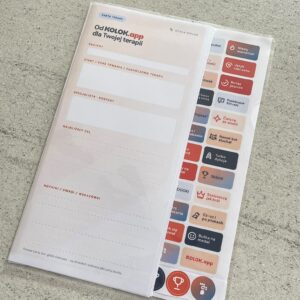
FIRST PAGE – therapy card:
-
PATIENT
it is important that the therapy is personalized and directly states the patient’s name.
-
START / DURATION / END OF THERAPY
the parent, the specialist and the patient alike need to feel in control during therapy – without it, motivation drops. A clearly laid-out schedule of sessions lets them picture the finish line, which motivates action.
-
SPECIALIST – CONTACT
a sense of safety is key in effective therapy. Steady contact with the specialist can provide it, as they will give the necessary guidance in even the most unusual situations.
-
NEAREST GOAL
this is about the skills/habits/attitudes the patient is meant to achieve by the end of therapy. Sometimes these may be correct swallowing movement patterns, breathing through the nose or a correct tongue resting posture. It is important that the goal is clearly defined and written in language suited to the patient.
-
NOTES / REMARKS / TIPS
this is a field for various additional information – you can include a grocery shopping list, a trainer you recommend for a given set of exercises, or a recommended website where the patient will find the necessary information.
-
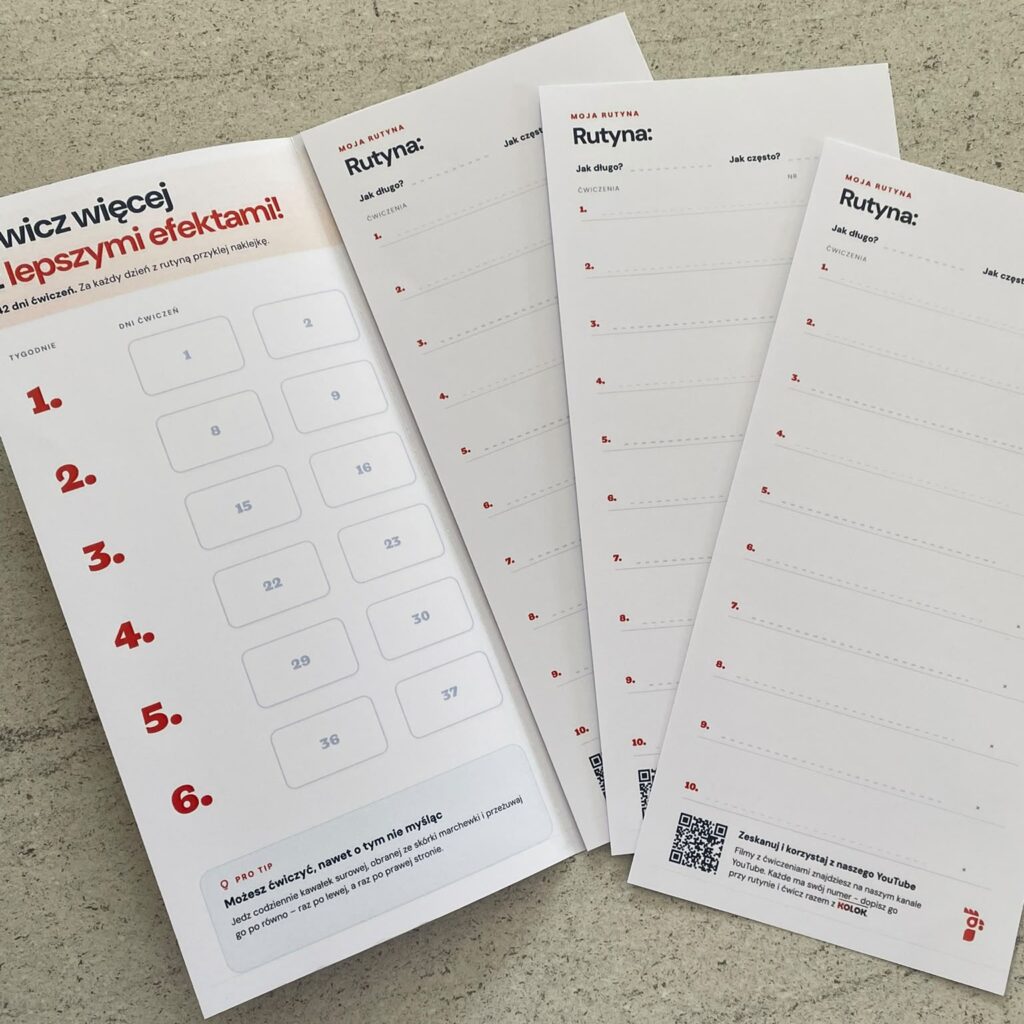
- We open the tab where we defined who the patient is, what they are working toward and what they should keep in mind. Now we will define what the Routine is.
ROUTINE:
-
HOW LONG?
here it is best to state the number of days or weeks the patient should practice the set of exercises we describe below. Make sure the period you set matches the date of the next session. Be careful about recommending a single set of exercises for a whole 6 weeks – this usually has a negative effect on the patient’s motivation, because they do not see progress and do not feel the point of the effort they are putting in. Together with the patient you can change the exercises they have already mastered, for example after 2 weeks – the additional ROUTINE pages, which you will find in the set we provide or in the free PDF to download, are meant for this.
-
HOW OFTEN?
this is about the number of repetitions per day/week – depending on the situation. We recommend the small-steps method – it is better to have fewer exercises, but frequently – every day or twice a day – instead of big training blocks twice a week.
-
EXERCISES
this is where the most important part appears. The patient must know what to do and how. At the same time, there cannot be too many of them – this overwhelms the patient and negatively affects their motivation. You have 10 rows in which you can specify the exercise name, its number, and the number of sets and repetitions. Let’s break it down:
- Exercise name – as you see fit, the important thing is to avoid misunderstandings. We help you solve this problem by providing a free exercise library – both on our YouTube channel and on our website. We are aware that the range of materials is not yet complete, which is why we are actively adding more videos. If something is missing, get in touch on the kolok.app website – we will record the exercise we overlooked for you!
- Number (kolok code) – each of our exercises has its own code – to make communication easier. You will find this code at the beginning of the description of each of our YouTube videos. What is more – every exercise is available in several languages. Exercise D02 comes in versions D02 PL, D02 EN, D02 DE, etc. This makes it possible to pass on training materials in the patient’s language – without the need for translation).
- SETS X REPS – the number of sets and repetitions – like at the gym (e.g. 3 x 5 sec.). Indicate here how many times and for how long the patient should repeat the given exercise. You have to adjust the units of measurement yourself, depending on the exercise.
- QR CODE – turn on the camera on your smartphone and point it at this code to go to our YouTube channel and see the full exercise library. The patient has access to it at any time. At the beginning of each exercise there is a kolok code -so that the patient knows exactly which one it is!
-
-
TIME FOR THE PATIENT’S PAGE!
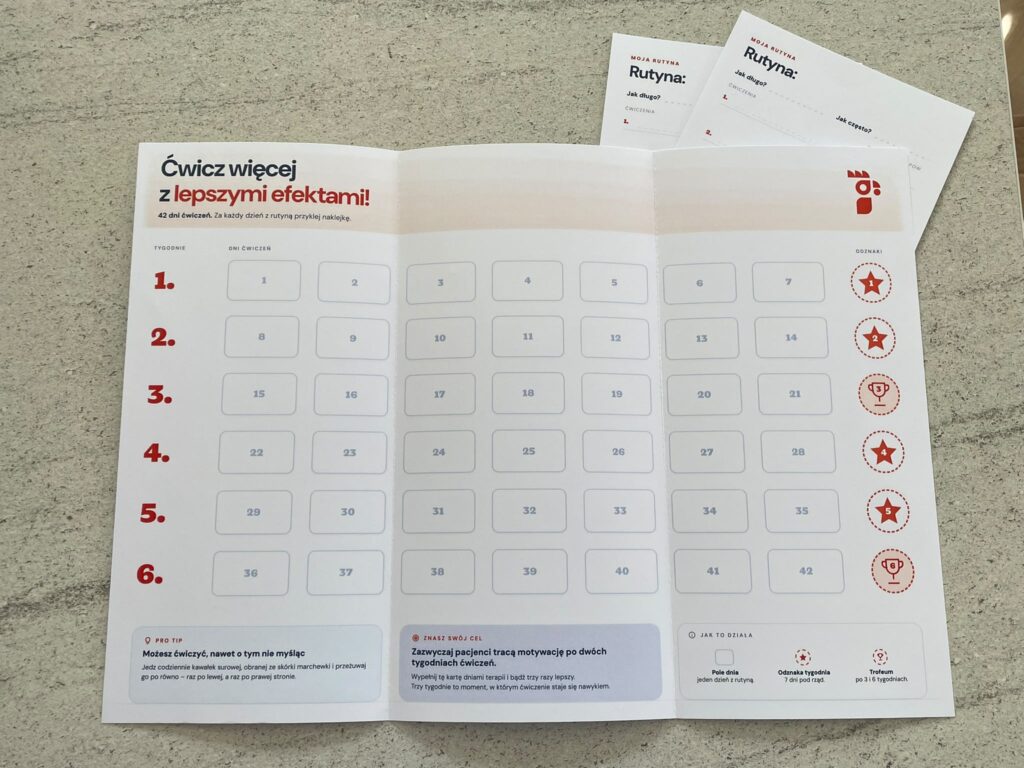
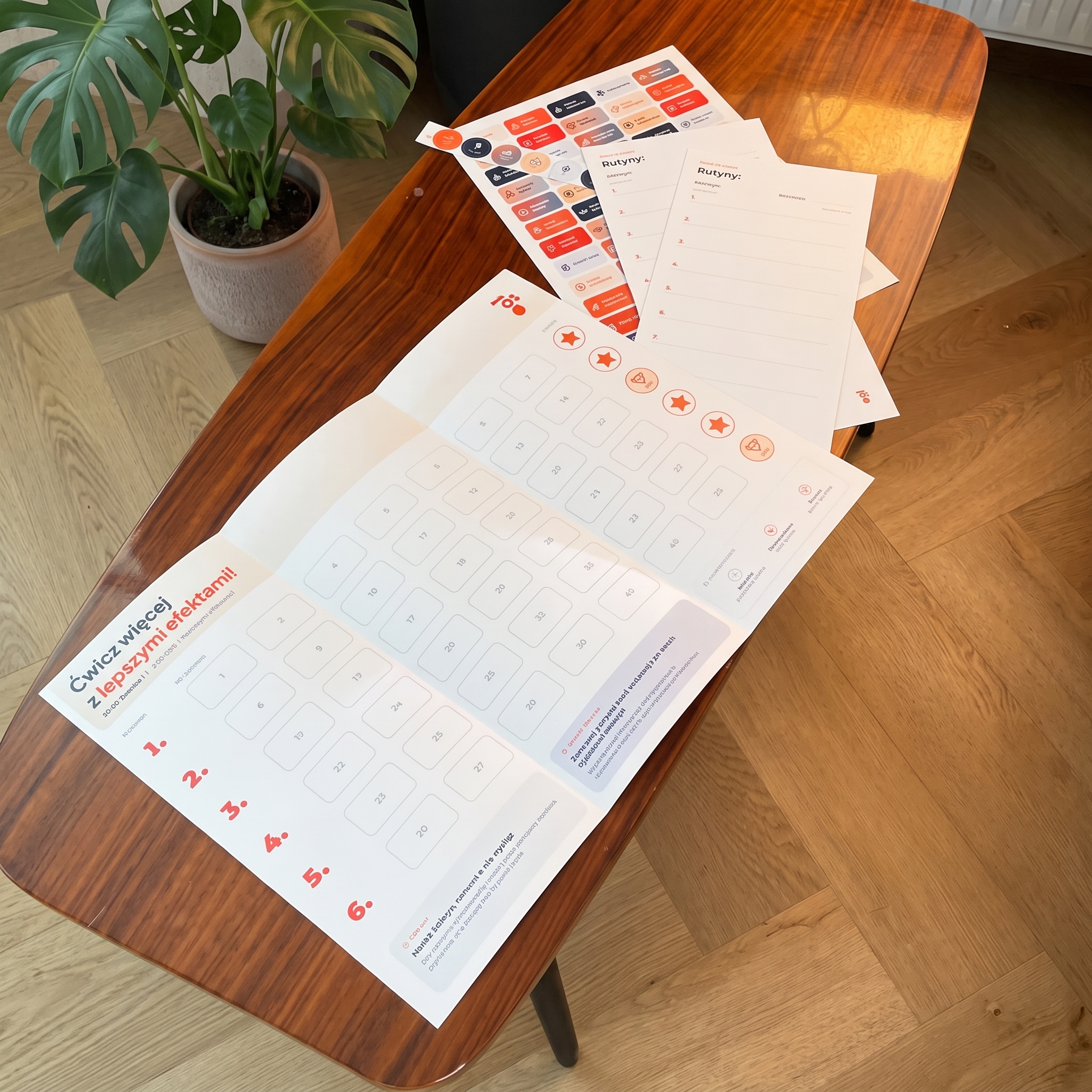
That is all you need for the patient to know exactly what to do and when! After you lay the card out flat, on its back there is a board with 42 rectangular spaces – divided into 6 weeks – marked with round “trophy” spaces. This number is no accident. Interviews with specialists show that patients’ motivation to exercise drops after just one week, and they usually stop exercising after 2 weeks. Scientific research says a habit is built after 3 weeks of regular exercise. The kolok offline therapy card aims to build that habit and sustain it for up to 6 weeks – that is an exercise period 3 times longer than what speech therapists typically observe!
-
GAMIFICATION – what is it and how does it work on the patient?
Gamification is bringing mechanisms known from games (such as points, levels, badges or competition) into the real world to encourage people to complete specific tasks. A sticker on its own is just a physical object, but in the right context it becomes a badge or visual confirmation of progress. We use this trick to boost motivation. We designed 65 different rectangular stickers – for marking daily achievements. For the round spaces we have special round trophy stickers, for marking whole weeks of a streak – exercising several days in a row. This kind of system of collecting rewards and badges gives motivation – it is easier for the mind to carry out a plan because it sees the goal and how it gets closer to it every day, in small steps.
-
THE PATIENT’S PART
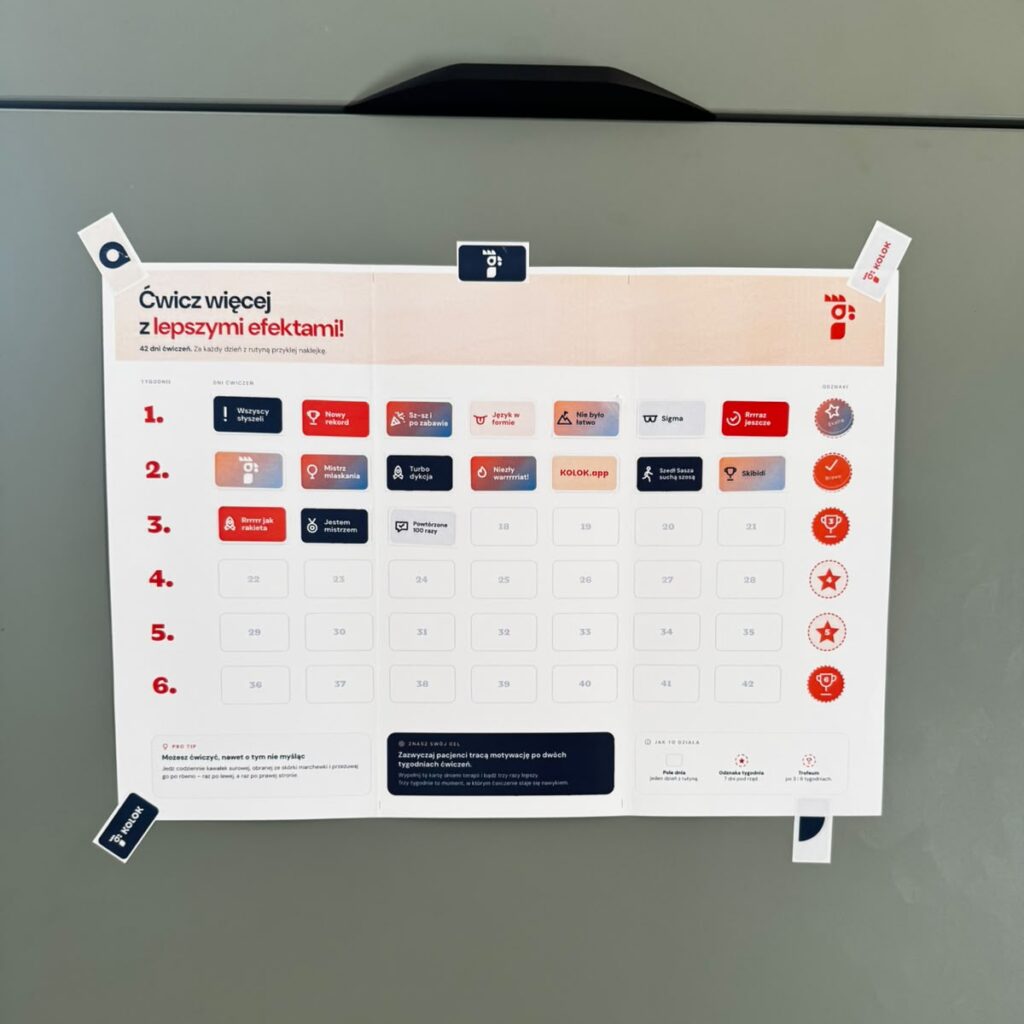
You can confidently hand the board and the set of stickers over to the patient.
The patient starts therapy by sticking on one sticker for each completed day of the “Routine” – the set of prescribed exercises. Even if they do not remember what to do, all they need to do is look up the exercise they are meant to do on the YouTube channel or on our website, and the barrier disappears. Progress moves forward, and the results of the work are objectively visible. The specialist does not have to keep asking whether the patient practiced, whether they remembered what to do and whether they know why they are doing it. -
PROGRESS – ADDITIONAL “ROUTINE” CARDS
Now imagine this scenario. After 2 weeks the patient comes to you with the board. They have stuck stickers up to space 14, with two round trophy stickers at the end of the week. They do the exercises you recommended without any problem. It would be time to put together a more challenging plan so the patient can keep making progress. We do not want to destroy the traces of the patient’s progress. The set includes additional Routine cards, which you can fill in with a more challenging list of exercises and hand to the patient. The board with the stickers from the first two weeks is still up to date. You can see that “the work is done”, but the new range of exercises helps build greater progress on that foundation.
In other words:
- You can see the history of the therapy – the number of routines grows as time passes.
- You can see how many days of work have been completed – across different sets of exercises.
- The patient feels a sense of agency and sees how much they have already done.
- Sticking on stickers gives them a healthy dose of dopamine and helps them get through the toughest moments.
- The patient gets smoothly through moments of discouragement and continues exercising when they happen to slip up.
-
SUCCESS – the patient – shoulder to shoulder with the specialist
This is not about policing – it is about building motivation. Therapy takes place outside the clinic. A visit to the clinic is just guidance and a dose of knowledge about what to do and how. The rest depends on the patient, so we have to help make their life easier.
One session a week will not build a habit.
The specialist sets the direction, but the effect will only appear if the patient exercises after leaving the clinic. Consistency between sessions matters more than a single long exercise. A short session every day builds a habit and makes it possible to achieve real progress.
It is worth sticking to a simple plan:
a set time, a specific task and a visible small success. A child finds it easier to return to the exercises when they know what to do and why. If a day gets missed, get back to the plan the next day – everyone slips up sometimes, but the most important thing is to return to regular work.
Our board consists of 42 spaces – divided into 6 weeks.
Our goal is to motivate patients to exercise throughout that time.
– Specialists say patients give up after 2 weeks.
– Research shows a habit is built in 3 weeks, so the second half of the board should already be pure pleasure and a sprint to the finish line!
We do not want to produce boring leaflets explaining what the app is about.
That is why we made Kolok offline – a leaflet/brochure/tool for collaboration between the specialist and the patient.
The worksheet includes features that partly mirror our app – it just works without electricity.
This is how we came up with it:
1. Visual motivation and habit building (42 days of exercises).
The board was designed to solve the biggest problem in myofunctional therapy – the drop in motivation that appears in most patients after just two weeks. It offers as many as 42 days of progress tracking (6 full weeks), which is a cycle 3 times longer than standard worksheets. For each completed day, the patient sticks on a colorful, rectangular sticker with a motivational slogan, and the round “trophy” sticker that crowns each week gives extra satisfaction and helps cement the habit of a daily routine.
2. An individual plan and therapy goal in one place.
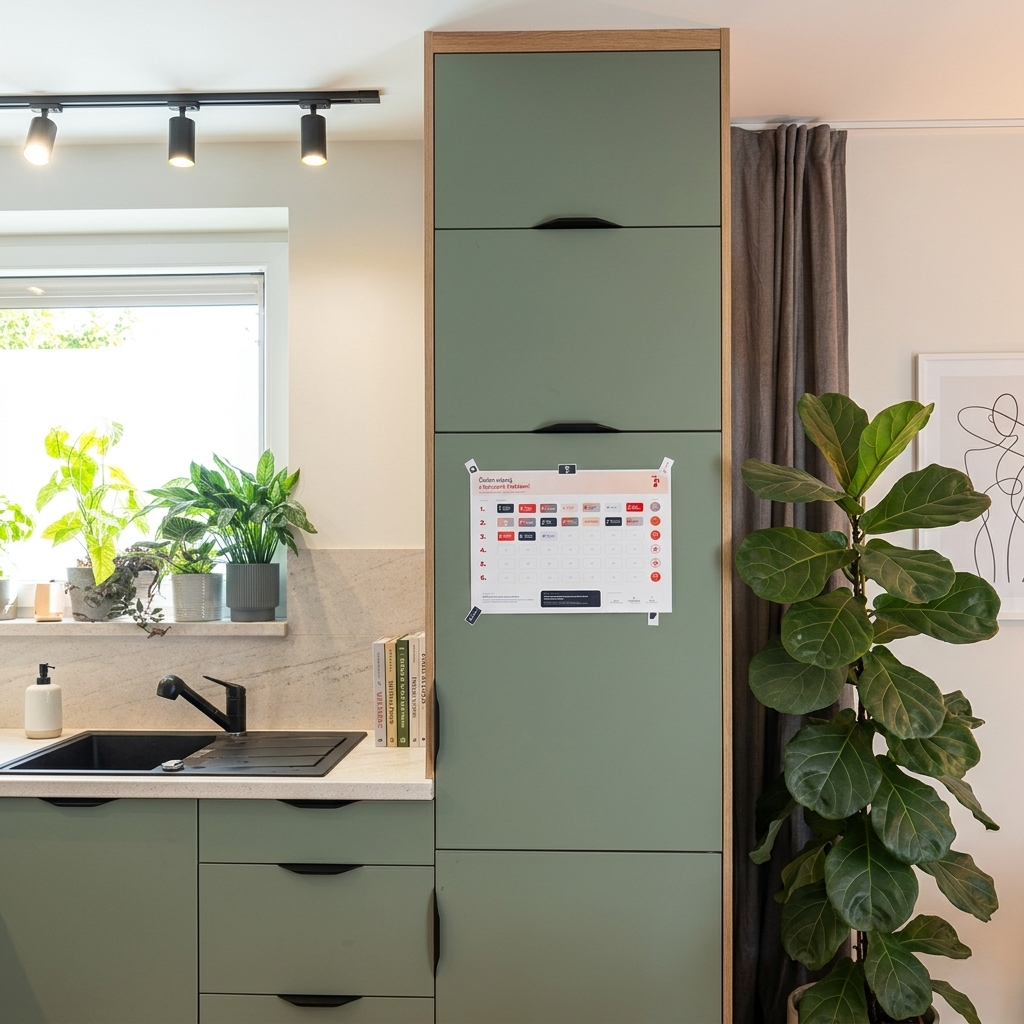
On the back of the card, the speech therapist has a clear space for personalizing the therapy. They write in the main goal, the recommended frequency and the exact set of exercises with the number of repetitions and sets. Thanks to this, the patient does not have to look for loose scraps of paper – all they need to do is hang the board in a visible place (on the fridge, desk or door) to have complete guidelines from their specialist at hand at any time.
3. Quick access to video instructions on YouTube.
To eliminate doubts about correct technique, every exercise in the list has its own unique number/code. At the bottom of the card there is a QR code and a direct link to the YouTube channel ([youtube.com/@kolok-app]), where you will find short instructional videos matched to each code. This lets the patient find the right video in a few seconds and exercise correctly and safely at home too.
The concept is simple – download the worksheet, print it and use it – and if you prefer an app, download it and get going!
If you like, write to us – we will prepare a pack of worksheets and stickers for you.