Instructions:
Body posture
Body position is key in these exercises. Sit up straight. Place your feet flat on the floor, bend your knees at a right angle and keep your torso perpendicular to the floor. Keep your head level, facing forward.
This helps you avoid compensation. Compensations in the body are unconscious defence mechanisms in which some structures or muscles take over the work of others when those are weakened, damaged or in pain.
Exercise
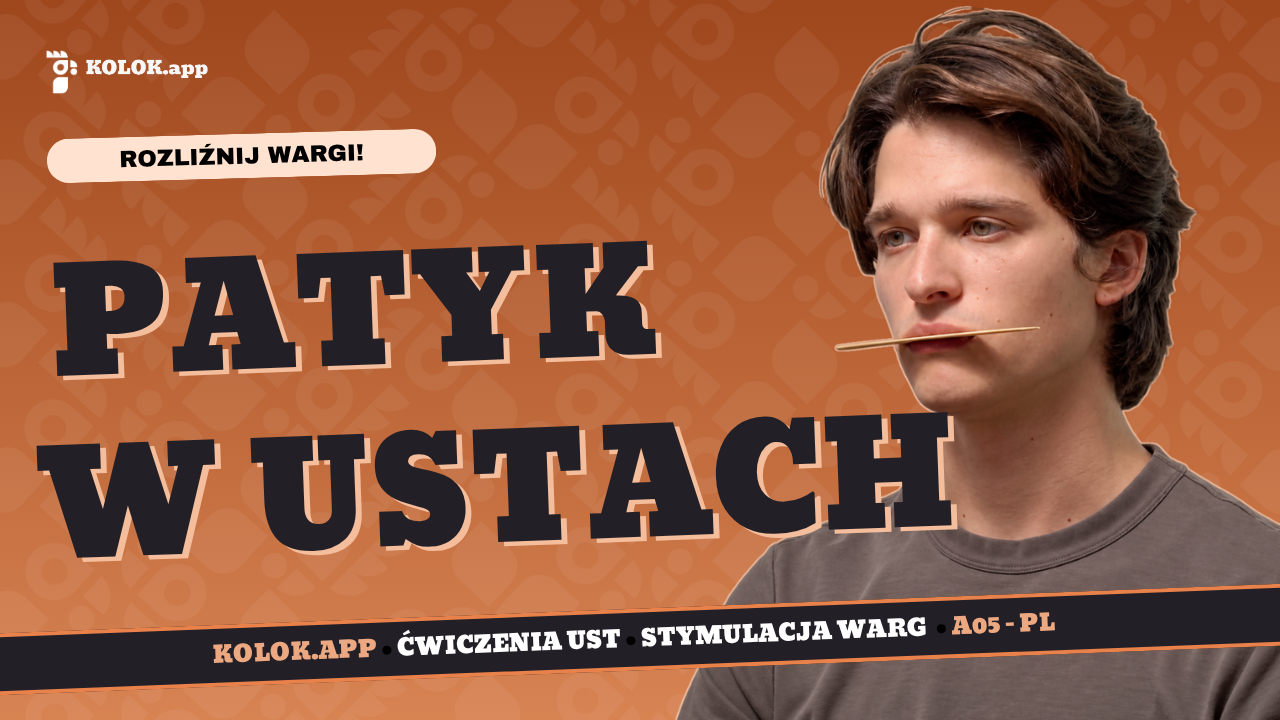
For this exercise you will need a wooden spatula. Relax your mouth. Slide the wooden spatula between your lips. Close your lips around the spatula comfortably so that it does not fall out. Hold for 5 seconds.
What does it work on?
- Orbicularis oris muscle (musculus orbicularis oris): Responsible for lip movements (narrowing, pushing forward). This exercise quickly reduces tension in this area, improving the flexibility and blood supply of the lips.
- Facial expression muscles (including the buccinator muscle – musculus buccinator): Air passing through the oral cavity gently puffs out the cheeks, which helps relax the entire muscular structure of the face.
- Breathing muscles (mainly the diaphragm and the intercostal muscles): To produce and maintain a steady lip vibration (the characteristic “prrr”), you need an even, controlled stream of air. This engages the muscles responsible for so-called breath support.
How will it help you?
- In speech therapy and diction exercises – it improves lip function, increases speech clarity and helps in the therapy of speech sound disorders (e.g. with interdental lisping or when eliciting the “r” sound).
- In voice production – it helps release tension in the articulatory apparatus before singing or public speaking, resulting in a lighter-sounding voice.
- Relaxation – it relaxes the masseter muscles and the whole face, which is helpful, among others, for people who unconsciously clench their teeth or struggle with stress.
Who is it for, and when does it work best?
The “horse snort” exercise works for people of all ages.
It serves different purposes for children, adults, and professional speakers or singers.
1. In children (as part of prevention and speech therapy)
- From infancy: As a natural game between parent and baby (e.g. during diaper changes or bath time). The child watches the adult’s mouth and eventually tries to imitate it, which stimulates the orbicularis oris muscle.
- At preschool age (2–6 years): As a regular part of so-called articulation stories and mouth and tongue gymnastics.
- When is it especially worthwhile?
- When the child has tense lips and cheeks or habitually breathes through the mouth.
- In myofunctional therapy (e.g. for interdental lisping).
- Before learning to pronounce more difficult sounds that require precise lip movements.
2. In adults, singers and people who use their voice at work
- Before public speaking or singing: As part of a speech apparatus warm-up. It quickly relaxes facial and laryngeal muscles tensed by stress.
- After intensive speaking: To reduce fatigue of the vocal cords and articulatory muscles (so-called voice cool-down).
- During stress relief: Snorting helps relax the jaw, where emotions often build up.
- While practising yoga, stretching or meditation.